Purpose-built for sleep and circadian science
Designed by researchers, for researchers
The web app is available now. Run everything from consent to export in the browser, with a dedicated dashboard for seamless study management. Native Android and iOS apps are on the roadmap.
CircadiaLog is currently available by invitation only. If you'd like to use it for your study, get in touch →
One platform, all your studies
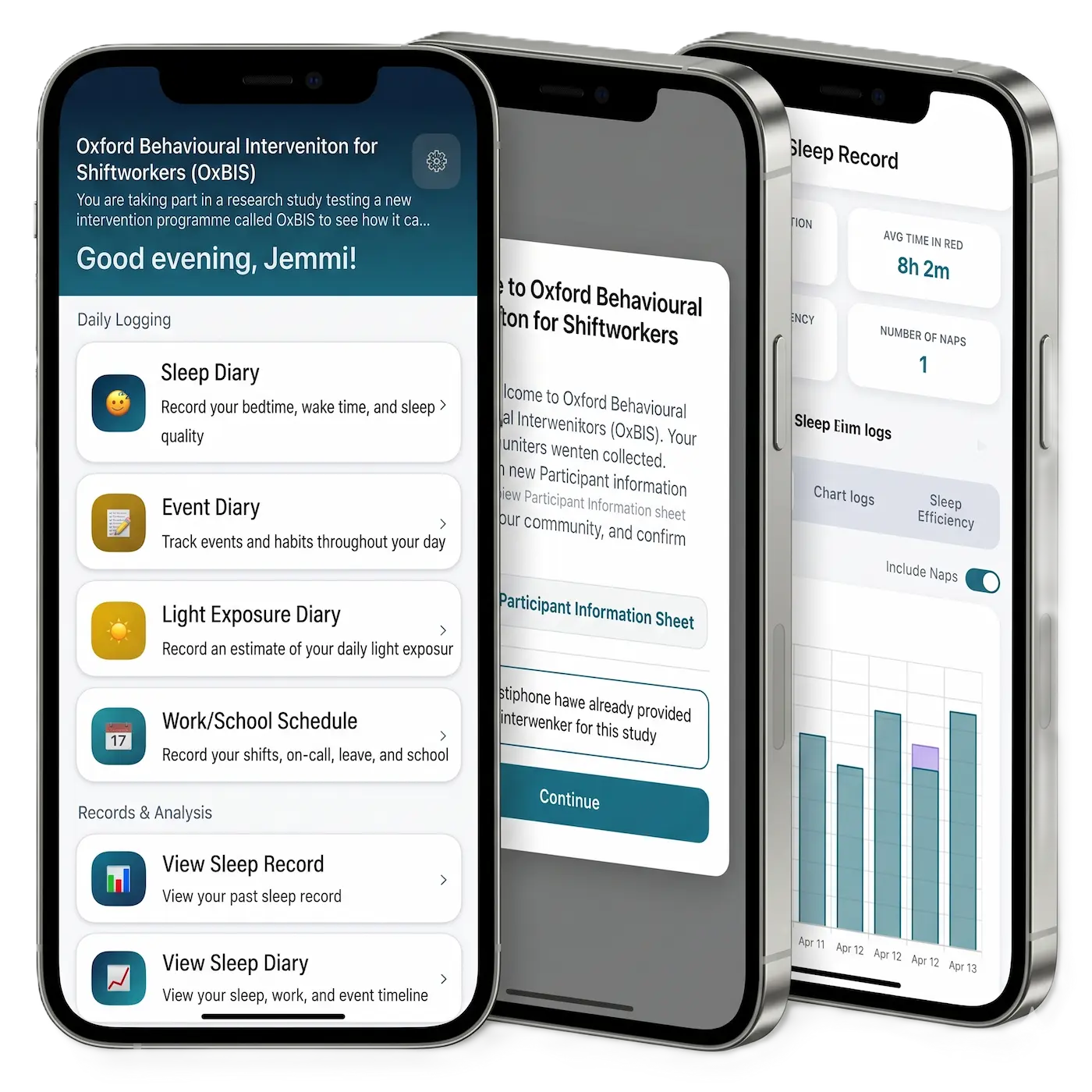
Run multiple studies from a single platform, each with its own assigned researchers, participants, and configuration. Role-based access controls who sees what, and strict data isolation ensures studies remain independent at every layer.
The right access for everyone on your team
CircadiaLog maps to how a research group works, with different roles for every level of your study. The examples below are just that, examples. You assign roles however fits your research group.
- Centre Admin Full control over your lab's studies, staff accounts, and participant data. Typically the PI, but could just as easily be a senior postdoc who runs the day to day.
- Researcher Runs assigned studies, manages participants, and exports data for analysis. Suited to Co-Is, research officers, or anyone with hands-on study responsibility.
- Project Manager Read-only access to assigned studies. Useful for RAs, placement students, or anyone who needs visibility without the ability to change anything.
- Participant A clean, focused mobile experience. Log diaries, complete questionnaires, nothing more.
Customise your study modules
Every module is fully customisable and togglable to suit your specific research needs. Capture sleep and circadian data with ease. Each entry is automatically timestamped, allowing for high-precision analysis of how behaviours and exposures impact sleep over time.
Sleep Diary
Capture timestamped sleep episodes with automated calculation of key metrics including TIB, TST, SOL, WASO, SE, and midpoint. Customise your diary with optional modules for naps, dream recall, and more.
Work Schedules
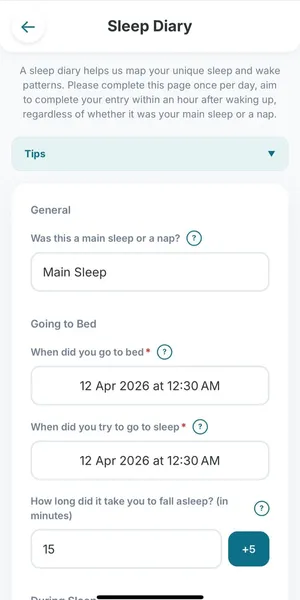
Seamlessly capture shifts, commute times, and on-call periods with native support for midnight-crossing entries. This module adapts to work, school, or on-call schedules using researcher-configurable labels.
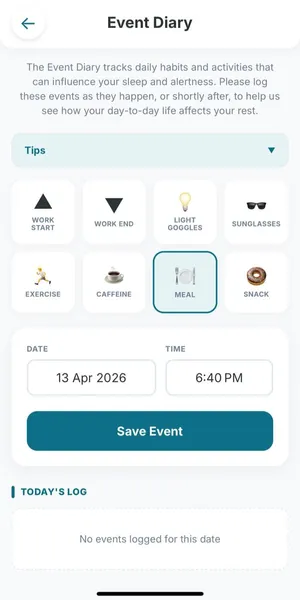
Event Diary
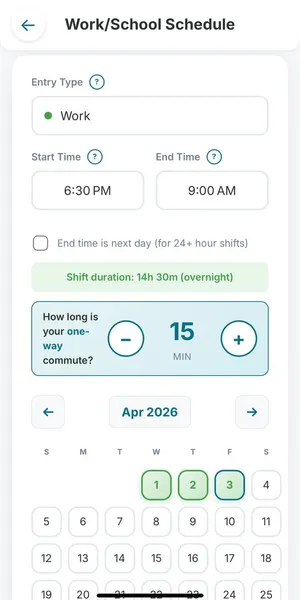
Capture timestamped activities with optional duration tracking for total flexibility. Define the specific event types required for your protocol such as medication, exercise, or alcohol.
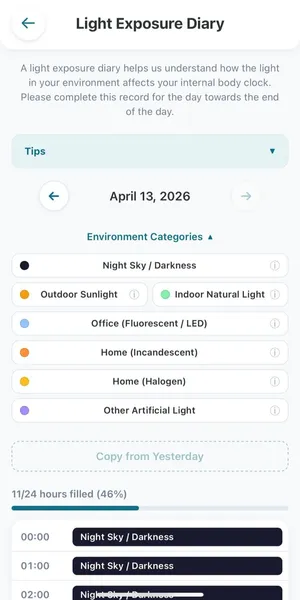
Light Exposure Diary
Log 24-hour light exposure based on the H-LEA questionnaire. This module auto-populates local weather data to provide environmental context and enhance the precision of light analysis.
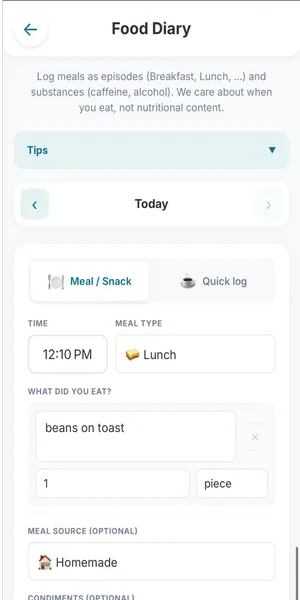
Food Diary
Purpose-built for chrononutrition research. Capture the timing of meals and substances. Each entry provides details for the timing of food and estimation of calorie and macronutrients.
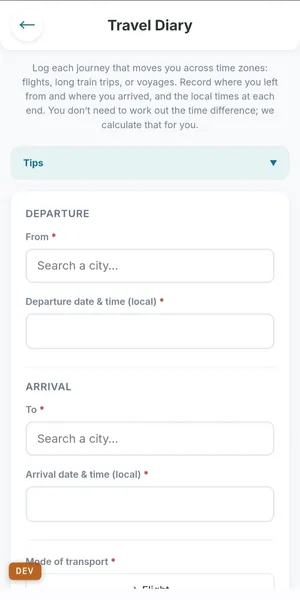
Travel Diary
Built for jet lag and travel research. Participants log each journey by departure and arrival location, and timezones crossed, travel duration, and stay duration at each stop are derived automatically.
Your protocol, your platform
No two sleep studies are the same. CircadiaLog is built for this reality and allows you to configure every aspect of your study without the need for compromises or technical workarounds.
Streamlined consent management
Collect consent digitally through the platform or simply confirm receipt of offline consent per participant. This flexibility ensures you can maintain your existing ethical workflows while providing study documents directly through the app.
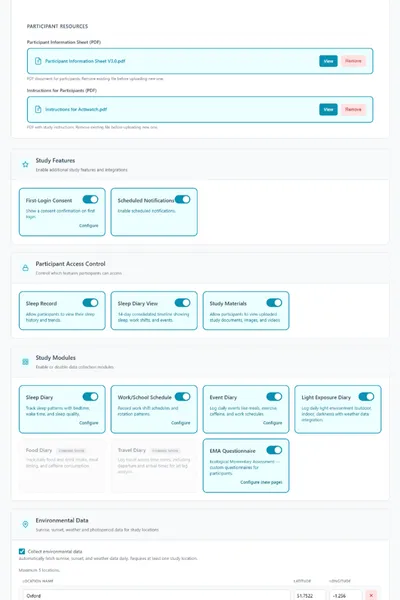
Toggle modules on or off
Activate only the diaries your protocol needs, including Sleep, Work Rota, Event, Light Exposure, and EMA questionnaires.
Customise each diary
Enable optional questions, define your own event types, set retrospective entry limits, and write your own shift classification rules and labels.
Define study stages and groups
Create Baseline, Intervention, Washout, or any stages you need. Organise participants into study groups and assign individual stage timelines with bulk assignment tools.
Communicate through the app
Send push notifications and display targeted study banners to all participants, or to specific stages only.
Smart notification scheduling
Automated reminders prompt participants to complete their diaries, with configurable timing per module and per study stage. Reduce missing entries without manual follow-up from your team.
Real-time study monitoring
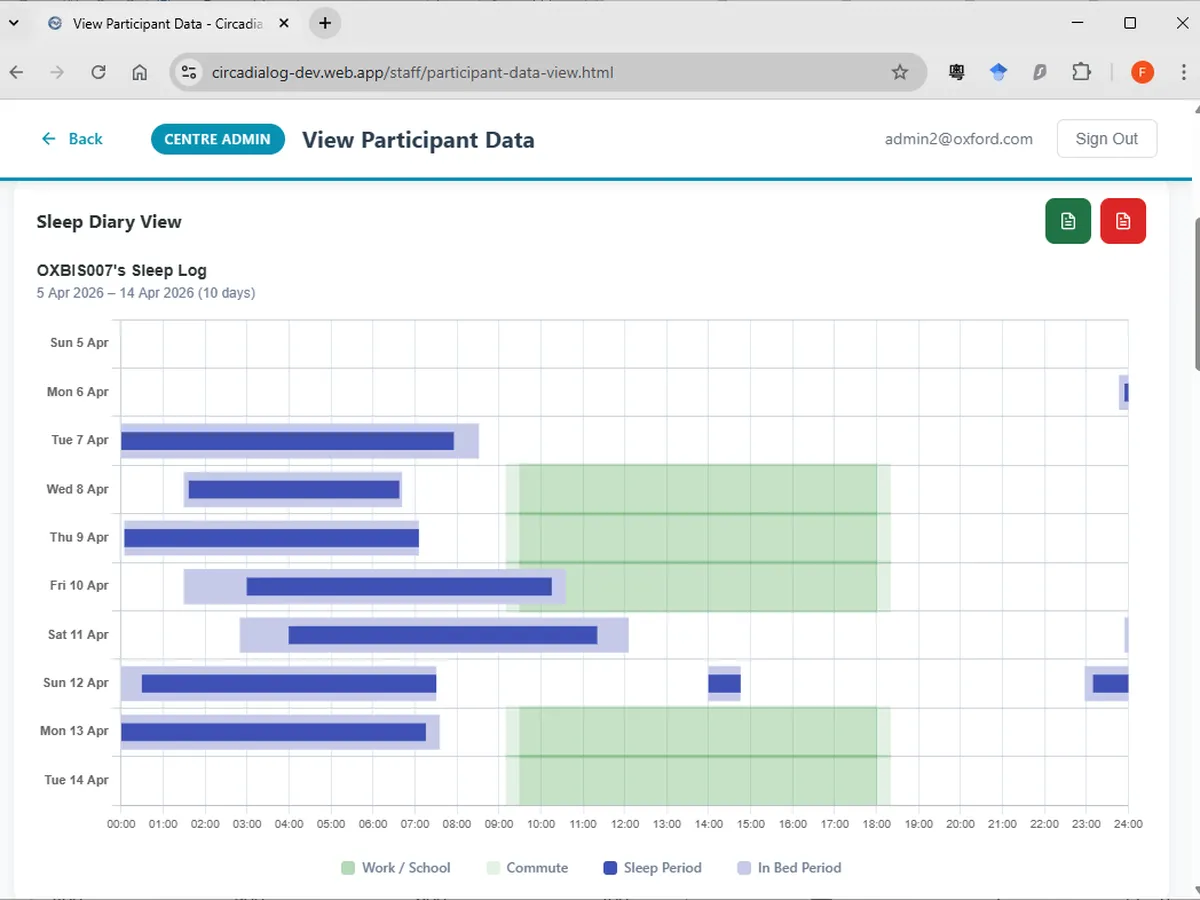
Eliminate the wait for manual data entry. CircadiaLog provides a live window into participant activity so you can identify issues early. Monitor compliance as it happens and intervene before data gaps become unrecoverable.
Instant actigram visualisation
Review participant sleep patterns at a glance with live actigram rendering. Monitor rest-activity cycles in real time without the need for back-and-forth communication or manual data exports.
Live compliance tracking
Visualise study engagement across your entire cohort. Track submission patterns and identify longitudinal gaps as they happen to ensure your protocol remains on schedule.
Proactive data integrity
Protect your dataset by identifying missed entries immediately. The dashboard highlights irregularities in real time so you can resolve participant challenges before they result in unrecoverable data loss.
Flexible, reliable EMA delivery
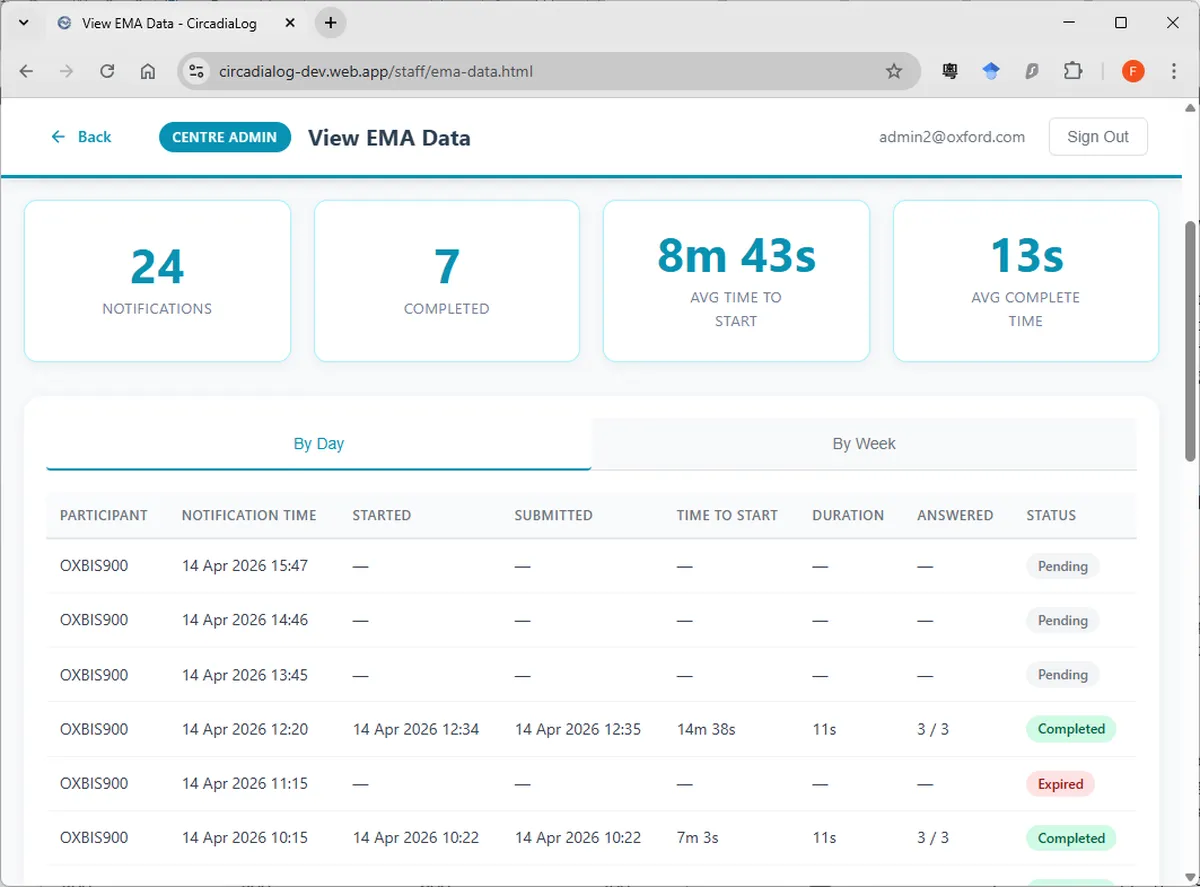
Build and manage custom questionnaires directly within the platform. Configure delivery windows to match your study protocol and monitor participant engagement live. CircadiaLog ensures data reliability even in the most challenging longitudinal research environments.
Three scheduling modes
Fixed times, random within windows, or block random, configured per study.
Timezone-aware
Per-participant schedule generation respects local timezones across international sites.
Smart push notifications
Reliable delivery with automated reminder sequences and configurable expiry windows.
Auto-save & resume
Participants can be interrupted mid-questionnaire. Responses are saved automatically on every change.
Version-controlled data integrity
Question text is snapshotted at submission. Questionnaire edits do not retroactively affect existing response data.
Compliance dashboard
Completion rates, average response times, and skip rates per participant per questionnaire.
Structured exports, ready for analysis
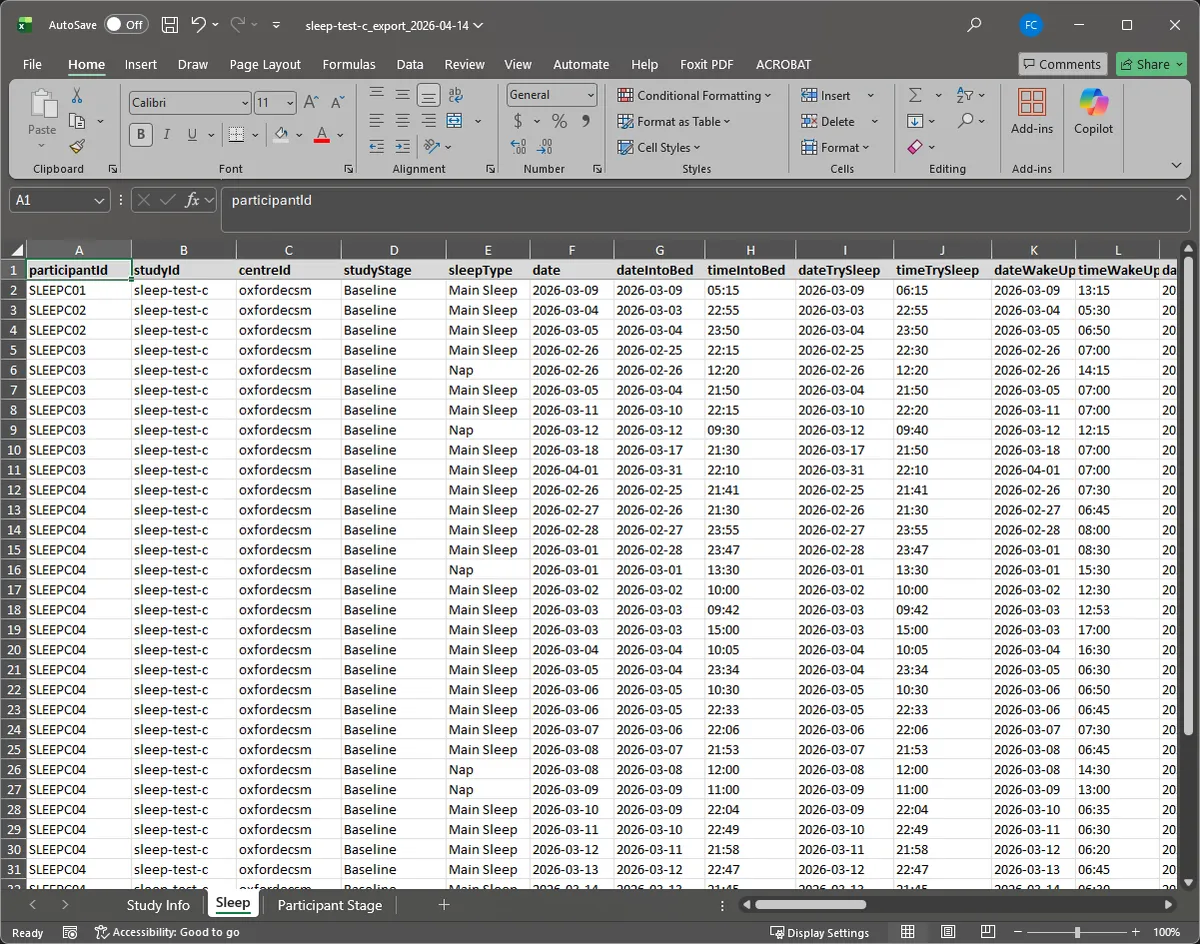
Every export is a set of structured CSV files delivered as a single ZIP archive, readily importable into SPSS, R, or any statistical software. Time values are captured with per-second accuracy in each participant's local timezone. All numerical data is exported to three decimal places to maintain maximum precision for your statistical models.
Raw Data Export
All diaries, travel journeys, and EMA responses with full timestamps and server-calculated metrics, one file per data type. For researchers who want to work directly with the raw data.
Environmental Data
Objective sunrise, sunset, photoperiod, weather, and sunshine duration data for your study location, matched by date. Particularly useful for circadian researchers correlating light environment with participant behaviour.
Built for compliance
Exports are available via time-limited download links and do not persist indefinitely. Every export is recorded in a full audit log for GDPR accountability.
Built for specialist research
Most tools are built for normative sleep or insomnia studies. CircadiaLog goes further with domain-specific capabilities designed for areas of science that are historically underserved. Whether your research focuses on shift work, chrononutrition, or jet lag, you no longer have to rely on multiple generic tools that were never designed for the complexity of your research area.
Shift Work Research
Participants log their work schedule directly in the app. CircadiaLog links every shift to its surrounding sleep and generates the outputs shift-work researchers actually need.
-
Modified consensus sleep diary
Supports sleep recording at any time of day, not just conventional overnight periods, making it suitable for shift workers across the full 24-hour cycle.
-
Define your own shifts
Create your own shift types and classification labels. Night shift classification follows your rules, including explicit researcher override.
-
Automatic sleep linkage
Pre-shift, post-shift, and on-call sleep episodes are identified and linked to each shift automatically, with on-call sleep tracked separately.
-
Quick return and night run detection
Short turnaround shifts and consecutive night shift sequences are flagged automatically, with position within each run tracked.
-
Transition typing
Onto night, off night, and night-to-night transitions are classified automatically, giving you the groupings your analysis already expects.
-
Aggregated by what matters
Summary statistics by shift classification and transition type, with circular means for all time-of-day averages.
Chrononutrition Research
Participants log their meals and substance intake through a purpose-built Food Diary that captures the timing of consumption. CircadiaLog cross-references every entry against sleep to produce the metrics chrononutrition researchers need.
-
Timing-first meal logging
Built for chrononutrition rather than calorie counting. Each meal episode is timestamped and described with free-text items, amounts, and units.
-
Configurable meals and substances
Up to 12 meal episodes per study (defaults: breakfast, brunch, lunch, dinner, and snacks) and up to 10 substances alongside caffeine, alcohol, and nicotine, each with configurable units and default amounts.
-
Built-in portion units
Common food portion units (cups, plates, bowls, slices, tablespoons, handfuls, and more) are built into the item form to support post-hoc estimation of energy intake and macronutrients.
-
Sleep cross-referenced summaries
Mean wake-to-first-meal and last-meal-to-bed are computed per study stage, so meal timing can be analysed against sleep-wake patterns.
-
Automatic eating and fasting windows
Daily eating and fasting windows are computed automatically from meal timestamps, alongside per-stage means and medians and dynamic per-substance totals.
-
Researcher-led field control
Optional meal source (homemade, takeaway, dine-out, canteen, other) and condiment fields can be toggled on or off per study to match your protocol needs.
Jetlag and Travel Research
Participants log each journey they take, and CircadiaLog derives the timezone exposure on the server. Journeys sit alongside the sleep record, so circadian misalignment during and after travel can be analysed without a separate travel log.
-
Journey logging by location
Each journey records a departure and arrival location, the local date and time at each end, mode of transport, and optional notes. The search covers roughly 11,500 cities with accurate timezones.
-
Timezone exposure derived automatically
Timezones crossed (signed for eastward and westward travel), travel duration, and UTC instants are computed on the server and are daylight-saving aware. Participants never need to enter a timezone themselves.
-
In-flight sleep captured
Sleep taken during a journey is recorded as a start and end time in the departure location's local time, with a subjective quality rating on the same scale used by the sleep diary.
-
Multi-leg trips with stay duration
Related journeys can be grouped into a single trip. Leg order and the stay duration at each stop are derived automatically, which is what round-trip and layover designs need.
-
Post-arrival questionnaire prompts
When a journey crosses timezones, participants can be prompted over the days following arrival to complete a questionnaire you host on Qualtrics or REDCap (or any platform reachable by URL).
-
Exposure data, not scores
Journeys are exported one row per leg, with trip identifier, leg sequence, and stay duration, leaving the jet lag model entirely to your analysis.
Designed for researchers. Built for participants.
CircadiaLog provides a clean and familiar mobile experience shaped by direct feedback from participants through a series of PPIE exercise. By removing technical friction, we ensure higher compliance and better data quality for your study.
Anonymous by design
Participants log in using only a study ID and password. This approach removes the need for emails or personal accounts while supporting pseudonymised protocols.
Low-friction diary inputs
A clean mobile interface designed for speed and clarity ensuring that logging is quick and intuitive, reducing the burden on your participants and keeping your study on track.
Configurable participant feedback
Provide participants with a visual record of their own sleep data. This feature can be disabled for studies where feedback might interfere with the protocol.
Offline-first reliability
The diary works without an active connection. This is essential for hospitals, secure environments, and remote sites. All data syncs automatically once connectivity is restored.
Multi-language support
Participants can interact with the platform in their preferred language. This allows you to run international or multi-site studies through a single unified app.
Frequently asked questions
Find what's relevant to you, whether you're evaluating CircadiaLog for an ethics submission, planning your study configuration, or reviewing the technical infrastructure.
Getting Started
Who is CircadiaLog designed for?
Sleep and circadian researchers at every stage of their career. It supports everything from single-site student projects to complex multi-centre international collaborations. If your study protocol involves sleep diaries or any other data captured by this platform, CircadiaLog is built for your specific workflow.
Is CircadiaLog available now?
I am currently in a controlled rollout phase and the platform is available by invitation only. If you are interested in using the platform for an upcoming study, please reach out to discuss your timeline.
How does onboarding work?
It starts with a brief conversation about your study and your specific data requirements. Once I understand your protocol, I can typically set up your research environment within a few days. From there, the platform is entirely self-service. Your Centre Admin can manage studies, staff, and participants through a dedicated dashboard. I am also happy to arrange training sessions for your team on request.
How much does it cost?
I am not a commercial software corporation. I offer CircadiaLog at cost to keep it accessible for academic research and significantly more affordable than commercial alternatives. Because every study varies in scale and duration, I discuss pricing on a per-project basis. Get in touch to talk through your requirements and we can figure out a budget that works for your funding.
Can I use CircadiaLog for a student dissertation project?
Absolutely. I know how difficult it can be to run a study as a student. Small-scale projects without dedicated funding can apply to use the platform at no cost. I am genuinely committed to supporting the next generation of researchers in our field. If you are a student working on a dissertation or thesis project, send me a brief description of your work and I will do my best to help you get started.
Scientific Capability
What types of data can CircadiaLog collect?
CircadiaLog offers seven independent data collection modules, each of which can be enabled or disabled per study:
- Sleep Diary: bed/sleep/wake times, quality, and optional contextual questions.
- Event Diary: timestamped events such as exercise and medication, with up to 12 custom types.
- Work Rota: shift start/end with automatic day/night classification.
- Light Exposure Diary: hourly H-LEA framework with 7 environment categories.
- Food Diary: chrononutrition-focused logging of meal episodes and substances (caffeine, alcohol, nicotine, or custom), with per-phase eating-window summaries.
- Travel Diary: journeys logged by departure and arrival location, with timezones crossed, travel duration, and stay duration derived automatically.
- EMA Questionnaires: custom ecological momentary assessments with flexible scheduling.
Can I run multi-arm or multi-phase studies?
Yes. CircadiaLog supports up to 10 study arms (e.g., intervention vs. control) and 20 study stages (phases). Study announcements, materials, and notifications can be targeted to specific arms or stages. Participants can be moved between stages with defined start and end dates.
Can I customise what participants see and record?
Yes, extensively. Every aspect of the participant experience can be tailored to your protocol. For example, you can enable or disable individual sleep diary questions, define custom event types, control whether participants can view their own sleep history, and set how far back retrospective entries are allowed. Study documents can also be gated by study phase. If you are wondering whether a specific configuration is possible, get in touch.
How does the EMA system work?
Researchers design questionnaires using a visual builder with four question types: multiple choice (single or multi-select), Likert scales, and visual analogue sliders. Up to 30 questions per questionnaire. Pre-built templates are available for commonly used measures including PANAS, PANAS-SF, KSS, and SSS, which can be used as-is or adapted to your protocol.
Three scheduling modes are available: fixed daily times, random prompts within a time window, or block-randomised schedules. Prompts are timezone-aware and delivered as push notifications. Each prompt has a configurable response window with an automatic reminder if the participant has not yet started.
What is environmental data?
For studies with a configured location, CircadiaLog automatically retrieves objective environmental data daily from the Open-Meteo archive, including sunrise and sunset times, photoperiod, cloud cover, sunshine hours, UV index, temperature, and weather conditions.
Environmental data is fetched using a study-level coordinate defined by the researcher, not the participant's device location. CircadiaLog never requests device location or GPS access. Where the Travel Diary is enabled, participants themselves report the places they travel between, which is self-reported rather than detected. This data requires no input from participants and is collected entirely by a background process.
It is included as an optional file in the study data export, allowing researchers to cross-reference sleep and light exposure records against objective environmental conditions on the same dates.
What sleep metrics and analytics does CircadiaLog provide?
All metrics are calculated server-side from participant diary entries, ensuring consistency across dashboards and exports. Core sleep metrics include TIB, TST, Sleep Efficiency, SOL, WASO, sleep midpoint (MSFsc), social jetlag, catch-up sleep, and night-to-night variability (SD and RMSSD). Weekday and weekend splits are calculated automatically.
For shift-work studies, the analysis engine links sleep episodes to shifts, producing metrics by shift type, transition effects, quick returns, and consecutive night-shift runs. All time-of-day averaging uses circular means, handling midnight-crossing times correctly.
Per-participant dashboards give researchers access to compliance rates, data quality indicators, and trend visualisations without needing to export first.
Was CircadiaLog developed with Patient and Public Involvement (PPIE)?
Yes. The development process included two rounds of workshops and direct dialogues between myself and public members. These sessions were facilitated by a PPIE expert and involved a group with diverse cultural backgrounds who have lived experience with sleep problems and shift work. Their specific insights and feedback were instrumental in shaping the UI and UX of the app to ensure it remains practical for real-world research.
Participant Experience
What devices does CircadiaLog support?
CircadiaLog runs in any modern web browser on a phone, tablet, or computer, so participants do not need to download anything from an app store. It can be added to the home screen to behave like an installed app, which is the recommended setup and is covered by the participant setup guide. Native Android and iOS apps are on the roadmap. Data syncs seamlessly regardless of how participants access the platform.
What are the minimum device requirements?
Any current version of Chrome, Safari, Firefox, or Edge, on Android, iOS, Windows, or macOS. Push notifications on iPhone or iPad additionally require iOS 16.4 or later, and the participant must add CircadiaLog to their home screen before notifications can be enabled. On Android and desktop, notifications work once browser permission is granted.
Does CircadiaLog work offline?
Yes. CircadiaLog is designed offline-first. Participants can log their diaries without an internet connection. Entries are stored securely on the device and automatically sync when connectivity returns. The app has been designed to support extended offline periods of 40 days or more, suitable for remote fieldwork, expeditions research, or in areas with limited connectivity. Please note that EMA questionnaires currently require an internet connection to be delivered and completed; offline EMA support is planned for a future release.
Is CircadiaLog available in multiple languages?
The participant-facing interface is currently English only, but the localisation infrastructure is fully built and ready for most major languages (except for Arabic and Hebrew). Adding a new language requires translating a single file with no code changes needed.
Researchers who need a specific language are welcome to contribute a translation themselves. All localisation contributions will be credited.
Is CircadiaLog accessible to participants with disabilities?
The participant interface is designed with accessibility in mind and aims to meet WCAG 2.1 Level AA standards. Specific measures include colour contrast compliance for all interactive elements in both light and dark themes, screen reader support with ARIA labels throughout the interface, and automatic reduction of animations for participants who have enabled reduced motion at the operating system level.
Can individuals under 18 participate in studies?
Yes, provided the research group has appropriate ethical approval and has obtained verifiable parental or guardian consent before enrolment, in accordance with applicable law (e.g., GDPR Article 8 in the UK and EU) and local research ethics requirements. Because participant accounts are created by research staff, not through self-registration, CircadiaLog does not interact with minors directly; the research group handles the consent process outside the app using its own approved protocol.
Data Security and Privacy
Is CircadiaLog GDPR compliant?
Yes. GDPR compliance is built into the platform architecture. Participants can submit data access and deletion requests directly through the app with automatic 30-day compliance deadline tracking. When a participant withdraws, their personal identifiers are permanently removed while research data is preserved under an irreversible anonymous code, maintaining dataset integrity. Participants register with synthetic identifiers (e.g., oxford-P001), so no personally identifiable information is stored alongside research data. All staff actions are logged, archived after 60 days, and retained for 3 years. CircadiaLog operates as a Data Processor; your research group remains the Data Controller.
Who controls the data?
Your research group is the Data Controller. CircadiaLog operates strictly as a Data Processor, handling data only as instructed by your research group and in accordance with applicable data protection regulations. Data ownership remains with the research group at all times.
Who are the third-party sub-processors?
CircadiaLog uses a single sub-processor: Google Firebase for cloud infrastructure (database, authentication, file storage, hosting). All application data is stored in London (europe-west2) and no participant diary data leaves the Google Cloud infrastructure.
Two additional third-party external services support non-personal operational functions: Resend for transactional email delivery (staff email addresses only, never participant data), and Open-Meteo for weather and daylight data (study-level location coordinates only, never participant data).
Where is participant data stored?
All data is stored on Google Cloud infrastructure in the europe-west2 (London) region. Data is encrypted at rest using AES-256 and encrypted in transit using TLS. Data does not leave the UK or EU under any operational circumstance. No data is stored on third-party servers outside of Google's infrastructure.
What data does CircadiaLog collect about participants?
CircadiaLog collects only what is necessary for the research protocol. Data collected includes participant generated diary entries, EMA questionnaire responses, and study metadata required to run the study.
No real-world personal identifying information is collected at any point. Participants are not registered with a name or email address. Each participant is assigned a study identifier by the researcher before enrolment, and this identifier is the only credential used within the platform.
What data does CircadiaLog not collect?
Other than participant identifiers, CircadiaLog does NOT collect any personal identifying information, including names, email addresses, phone numbers, or any other real-world identifying information. It does not collect device location or GPS data. It does not collect biometric data. It does not use cookies for tracking or advertising. It does not share any participant data with third parties for any purpose other than platform operation. It does not use participant data for any purpose beyond operating the platform on behalf of the research group.
How are participants anonymised?
Participants log in using a simple Login ID and password; no personal email address is required. The Login ID follows a centre-specific format (e.g., oxford-P001). Researchers create accounts and set initial passwords, which participants can change after first login. This approach supports pseudonymisation by design, as no real-world identity is captured in the login process.
How is participant data protected from unauthorised access?
CircadiaLog enforces strict data isolation through multiple layers: role-based access control with four access tiers (Centre Admin, Researcher, Project Manager, Participant); centre-level isolation enforced at the database level so staff in one research group cannot access another research group's data; study-level scoping so researchers only see data for assigned studies; and participant isolation so participants can only access their own entries.
Can participants request access to their data or request deletion?
Yes. Participants can submit data access or deletion requests directly from within the app. Requests are routed to centre administrators with automatic 30-day deadline tracking and email notifications. The platform provides a full workflow for staff to acknowledge, process, and complete these requests.
Is there an audit trail for staff actions?
Yes. CircadiaLog maintains a comprehensive audit log covering over 40 action types, including participant creation, data exports, account deletions, GDPR request handling, and study configuration changes. Logs are archived after 60 days and retained for 3 years. Centre administrators can search, filter, and export audit records at any time.
Does CircadiaLog use AI or machine learning on participant data?
No. CircadiaLog does not apply any AI or machine learning processing to participant data. All calculations (sleep metrics, shift classifications, etc.) use deterministic, published algorithms. Data is used solely for the purposes defined by each study.
Where can I read the privacy policy?
The full privacy policy is available inside the app, at the bottom of the Settings screen. You can also read it on the web.
Data and Analysis
What happens if a participant withdraws from a study?
The participant's account and profile are permanently deleted, and all standing notification schedules are removed. Research records are anonymised: the participant identifier is replaced with a randomly generated anonymous code with no reverse-mapping. No identifying information is retained after withdrawal.
What happens to data when a study ends?
Upon study conclusion, all participant data associated with that study is permanently and irrecoverably deleted from the platform. This includes all diary entries, questionnaire responses, notification schedules, phase assignments, and study materials. Deletion is triggered manually by the research team in accordance with their ethics approval and institutional data retention policies.
How is data backed up?
Participant data is protected by two simultaneous backup mechanisms. Point-in-Time Recovery maintains a continuous version history at minute-level granularity over a rolling seven-day window, allowing recovery of any document at any specific minute within that period. Daily snapshots provide a longer-term safety net retained for thirty days. Backups are strictly an infrastructure recovery mechanism and are not accessible to researchers or participants.
What export formats are available?
Bulk study data exports as a ZIP archive of CSV files, one file per data type plus a summary file. Individual participant exports (for GDPR data access requests) use NDJSON format. Per-participant shift and sleep analyses can also be exported as PDF reports.
Can I filter what data gets exported?
Yes. Exports can be filtered by date range, study stage and study arm, specific participants (all or a selected subset), and data type (sleep diary, events, work rota, light exposure, travel journeys, environmental data). Each export includes a summary file with metadata: export date, study name, participant count, and record counts per data type.
Notifications
How are participants reminded to complete their diaries?
CircadiaLog supports multiple notification types: Daily reminders at participant-chosen times, delivered as native device notifications; EMA prompts with automatic 15-minute follow-up reminders; Scheduled notifications timed relative to each participant's personal schedule; and On-demand messages sent by researchers through the Notification Centre.
What is anchor-based notification scheduling?
Researchers can define up to 5 time anchors per study, named reference points tied to each participant's daily routine (e.g., "Wake Time", "Bedtime", "Meal Time"). Notifications are then scheduled relative to these anchors (e.g., "Wake Time + 50 minutes"). Each participant's anchor times are personalised, so notifications arrive at the right moment for each individual, even across different time zones.
Can I communicate with participants through the app?
Yes. Researchers can send push notifications to individual participants or broadcast to an entire study. Study banners, colour-coded announcements displayed at the top of the participant dashboard, can be used for longer-running communications, with options for manual, date-based, or relative timing (e.g., "show 3 days after first login for 7 days").
Infrastructure
CircadiaLog is a multi-tenant platform. What does this mean?
Each research group operates in its own completely isolated environment within the platform. One group cannot see or access another group's studies, participants, or data. This isolation is enforced at the database level, not just in the user interface, so there is no technical pathway for data to cross between institutions. A researcher at one university cannot access data from another, even if both are using CircadiaLog.
How are participant accounts managed?
Researchers create participant accounts individually or in bulk via CSV import. Accounts can be activated, deactivated (preserving all data), or permanently deleted (with anonymisation). Participants can be assigned to study arms and moved between study stages. Password resets are handled by staff; participants do not need email access.
How many participants can a study support?
There is no hard system limit on participant numbers. Participant quotas are configurable per research centre. Researchers can import up to 500 participants at a time via CSV upload, making large-scale studies straightforward to set up.
How many studies can a research group run simultaneously?
There is no hard system limit on the number of concurrent studies a research group can run.
Can a participant be enrolled in more than one study at the same time?
Not within the same research group. Each participant account is scoped to a single study. If a participant needs to take part in two concurrent studies, they would require two separate accounts. This is a deliberate design decision to maintain clear data boundaries between studies.
Can CircadiaLog support studies across multiple time zones?
Yes. The platform is fully timezone-aware. Each participant's timezone is automatically detected on first login, and all notifications, EMA schedules, and time calculations respect the participant's local time. Researchers view data with timezone context, and all times are stored with UTC offsets for accurate cross-timezone analysis.
Get started with CircadiaLog
The web app is live and ready to use today. Native Android and iOS apps are on the roadmap.
To set up a study and onboard participants, please get in touch. CircadiaLog is offered to research groups by arrangement.